Ford Madox Ford
English writer and publisher (1873-1939)
1873–1939, born in London
Adventure & warNovels & literary fictionFantasy & science fiction
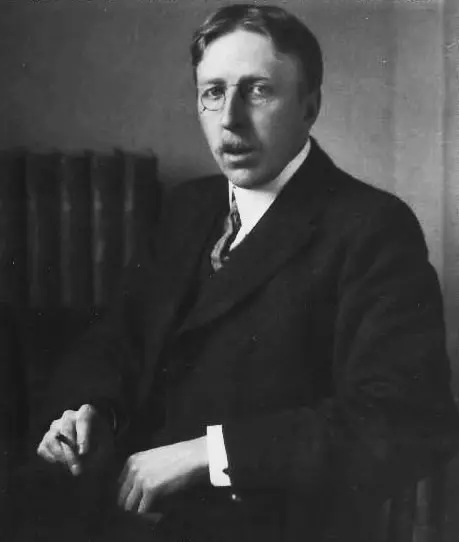
- Born
- 17 December 1873
- Birthplace
- London
- Died
- 26 June 1939
Notable works
- 1901 The Inheritors · read free
- 1906 The Fifth Queen
- 1910 A Call: the Tale of Two Passions · read free
- 1911 Ladies Whose Bright Eyes · science fiction
- 1915 The Good Soldier · psychological fiction · read free
- 1924 Parade's End · war novel
- 1924 Some Do Not … · military fiction · read free
- 1926 A Man Could Stand Up — · war novel
- Romance · read free
- The Nature of a Crime
From their work
What the artist wishes to do — as far as you are concerned — is to take you out of yourself. As far as he is concerned, he wishes to express himself.
Read the opening of The Good Soldier · about 2 min
THIS is the saddest story I have ever heard. We had known the Ashburnhams for nine seasons of the town of Nauheim with an extreme intimacy—or, rather with an acquaintanceship as loose and easy and yet as close as a good glove's with your hand. My wife and I knew Captain and Mrs Ashburnham as well as it was possible to know anybody, and yet, in another sense, we knew nothing at all about them. This is, I believe, a state of things only possible with English people of whom, till today, when I sit down to puzzle out what I know of this sad affair, I knew nothing whatever. Six months ago I had never been to England, and, certainly, I had never sounded the depths of an English heart. I had known the shallows.
I don't mean to say that we were not acquainted with many English people. Living, as we perforce lived, in Europe, and being, as we perforce were, leisured Americans, which is as much as to say that we were un-American, we were thrown very much into the society of the nicer English. Paris, you see, was our home. Somewhere between Nice and Bordighera provided yearly winter quarters for us, and Nauheim always received us from July to September. You will gather from this statement that one of us had, as the saying is, a "heart", and, from the statement that my wife is dead, that she was the sufferer.
Captain Ashburnham also had a heart. But, whereas a yearly month or so at Nauheim tuned him up to exactly the right pitch for the rest of the twelvemonth, the two months or so were only just enough to keep poor Florence alive from year to year. The reason for his heart was, approximately, polo, or too much hard sportsmanship in his youth. The reason for poor Florence's broken years was a storm at sea upon our first crossing to Europe, and the immediate reasons for our imprisonment in that continent were doctor's orders. They said that even the short Channel crossing might well kill the poor thing.
When we all first met, Captain Ashburnham, home on sick leave from an India to which he was never to return, was thirty-three; Mrs Ashburnham —Leonora—was thirty-one. I was thirty-six and poor Florence thirty. Thus today Florence would have been thirty-nine and Captain Ashburnham forty- two; whereas I am forty-five and Leonora forty. You will perceive, therefore, that our friendship has been a young-middle-aged affair, since we were all of us of quite quiet dispositions, the Ashburnhams being more particularly what in England it is the custom to call "quite good people".
Read the whole book free on Project Gutenberg Beautifully formatted edition on Standard Ebooks
Quotes from Wikiquote (CC BY-SA 4.0). Texts of this author are in the public domain in the UK.