Lord Byron
English Romantic poet and lyricist (1788–1824)
1788–1824, born in City of Westminster
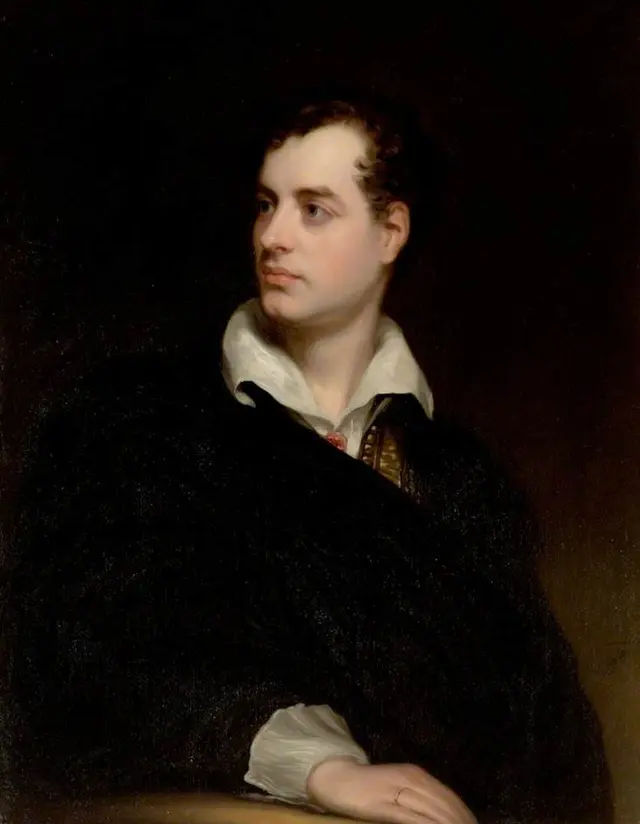
- Born
- 22 January 1788
- Birthplace
- City of Westminster
- Died
- 19 April 1824
Notable works
- 1812 Childe Harold's Pilgrimage · poetry
- 1813 The Giaour · Romantic poetry
- 1814 The Corsair · Romantic poetry
- 1816 The Prisoner of Chillon
- 1816 Parisina
- 1817 Manfred · tragedy, closet drama
- 1819 Mazeppa · epic poem
- 1821 Cain
- 1900 Don Juan · epic poem, digressive poem · read free
- She Walks in Beauty
From their work
A light broke in upon my brain, — It was the carol of a bird; It ceased, and then it came again, The sweetest song ear ever heard.
Read the opening of Don Juan · about 2 min
AS regards chronology, the epoch covered in the present volume is identical with that viewed in the preceding one. But now as regards subject matter we pass on to those diverse phases of the physical world which are the field of the chemist, and to those yet more intricate processes which have to do with living organisms. So radical are the changes here that we seem to be entering new worlds; and yet, here as before, there are intimations of the new discoveries away back in the Greek days. The solution of the problem of respiration will remind us that Anaxagoras half guessed the secret; and in those diversified studies which tell us of the Daltonian atom in its wonderful transmutations, we shall be reminded again of the Clazomenian philosopher and his successor Democritus.
Yet we should press the analogy much too far were we to intimate that the Greek of the elder day or any thinker of a more recent period had penetrated, even in the vaguest way, all of the mysteries that the nineteenth century has revealed in the fields of chemistry and biology. At the very most the insight of those great Greeks and of the wonderful seventeenth-century philosophers who so often seemed on the verge of our later discoveries did no more than vaguely anticipate their successors of this later century. To gain an accurate, really specific knowledge of the properties of elementary bodies was reserved for the chemists of a recent epoch. The vague Greek questionings as to organic evolution were world-wide from the precise inductions of a Darwin. If the mediaeval Arabian endeavored to dull the knife of the surgeon with the use of drugs, his results hardly merit to be termed even an anticipation of modern anaesthesia. And when we speak of preventive medicine--of bacteriology in all its phases--we have to do with a marvellous field of which no previous generation of men had even the slightest inkling.
All in all, then, those that lie before us are perhaps the most wonderful and the most fascinating of all the fields of science. As the chapters of the preceding book carried us out into a macrocosm of inconceivable magnitude, our present studies are to reveal a microcosm of equally inconceivable smallness. As the studies of the physicist attempted to reveal the very nature of matter and of energy, we have now to seek the solution of the yet more inscrutable problems of life and of mind.
Read the whole book free on Project Gutenberg Beautifully formatted edition on Standard Ebooks
Titan! to whose immortal eyesThe sufferings of mortality,Seen in their sad reality,Were not as things that gods despise;What was thy pity's recompense?A silent suffering, and intense;The rock, the vulture, and the chain,All that the proud can feel of pain,The agony they do not show,The suffocating sense of woe,Which speaks but in its loneliness,And then is jealous lest the skyShould have a listener, nor will sighUntil its voice is echoless.Titan! to thee the strife was givenBetween the suffering and the will,Which torture where they cannot kill;And the inexorable Heaven,And the deaf tyranny of Fate,The ruling principle of Hate,Which for its pleasure doth createThe things it may annihilate,Refused thee even the boon to die:The wretched gift EternityWas thine--and thou hast borne it well.All that the Thunderer wrung from theeWas but the menace which flung backOn him the torments of thy rack;The fate thou didst so well foresee,But would not to appease him tell;And in thy Silence was his Sentence,And in his Soul a vain repentance,And evil dread so ill dissembled,That in his hand the lightnings trembled.Thy Godlike crime was to be kind,To render with thy precepts lessThe sum of human wretchedness,And strengthen Man with his own mind;But baffled as thou wert from high,Still in thy patient energy,In the endurance, and repulseOf thine impenetrable Spirit,Which Earth and Heaven could not convulse,A mighty lesson we inherit:Thou art a symbol and a signTo Mortals of their fate and force;Like thee, Man is in part divine,A troubled stream from a pure source;And Man in portions can foreseeHis own funereal destiny;His wretchedness, and his resistance,And his sad unallied existence:To which his Spirit may opposeItself--an equal to all woes--And a firm will, and a deep sense,Which even in torture can descryIts own concentered recompense,Triumphant where it dares defy,And making Death a Victory.
Quotes from Wikiquote (CC BY-SA 4.0). Texts of this author are in the public domain in the UK.